About network studies
Prosopographical data in general can be divided into two types. The first one provides information about individual identities. Thus, prosopographic data forms the basic requirement for the manifestation of personal and social identities within a social community.
As a second type, prosopographical data is relational data which describe the interconnections and relations of individual persons, who can be assigned to a network of persons. Thus, prosopographical data is not just a criterion to identify a person, but it is a network parameter which forms the common basis for connecting people within the same network. According to Pierre Bourdieu (Bourdieu 1983: 191), those reciprocal personal interrelations generate social capital and as aresult, the social position and social status of an individual is strengthened by the participation to a network of persons. The participation to a group or a network can be defined by social and genealogical affiliations, gender, institutional background and geographic origin.
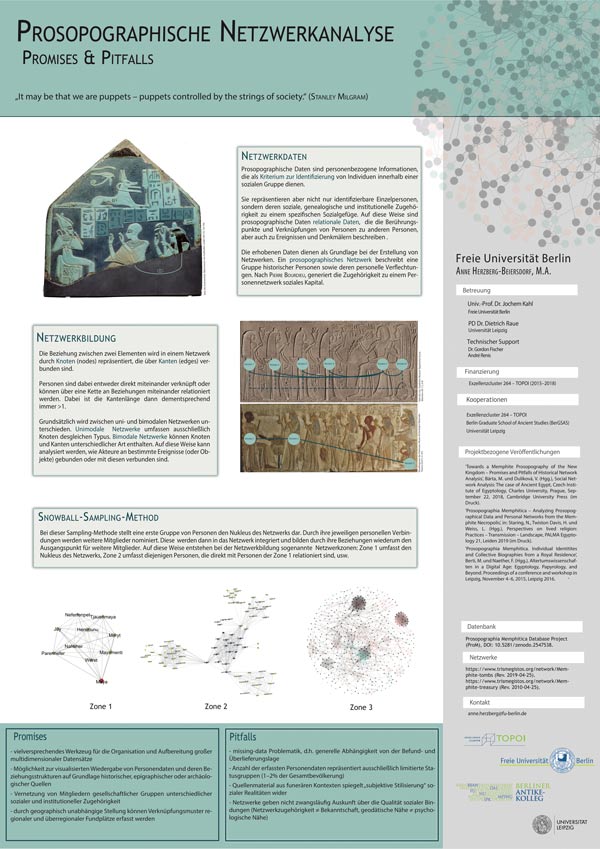
The basic principle of network studies is, that neither individuals nor social groups form the basic components of a social community, but the social relations, which are manifested in social networks (Düring – von Keyserlingk 2015: 338). A prosopographical network is a set of individual actors of a historical group of persons and their relations. By network analysis those relational patterns can be investigated by using graph theory (Prell 2012: 9). Within a network graph each person is represented by a node and each connection is shown as an edge. An individual might be connected to any other member of the network in a direct way, for example in case of genealogical affiliations. But as it has been already stated by the American psychologist Stanley Milgram (Milgram 1967: 60–70), individuals can be linked to each other indirectly by the common connection to other people as well. The shape of the network is irrelevant and nodes can be placed anywhere, but to create a network, nodes have to be connected by edges. In addition, there are many network measures to describe the features of a network, either as a whole, as well as those of individual nodes and edges (Prell 2012: 96–114). But what does this statistical measurement reveal about the relational patterns of the network?
"If two persons are five removes apart, they are far apart indeed. [...] Thus, when we speak of five intermediaries, we are talking about an enormous psychological distance between the starting and target points, a distance which seems small only because we customarily regard ‘five’ as a small manageable quantity."(Milgram 1967: 67)
In this way, statistical measurements of personal interrelations within a network have to be valuated with criticism, since it does rather describe the quantitative features of a network and its individual nodesand ties, than the quality of individual relations. According to Milgram’s observation, it has to be stated that although the distance between two individuals seems to be remarkably small, it is not evident if they were conscious of the fact that they participate to the same network and were connected by common acquaintances. As it has been mentioned above, prosopographical networks do not document the quality of social interrelations between individual actors based on personal contacts and therefore network graphs cannot be interpreted as an accurate reflection of the socio-historical past.
Although its application is neither limited to specific historical cultures, periods nor specific questions of research interest, historical network studies applied on data from ancient cultures does not occur regularly before the 2010s (Maczak 2005; Graham 2006a; Graham 2006b: 359–362; Ruffini – Graham 2007: 325–336). For Egyptology this method has so far been used only occasionally and remains mostly limited to Greco-Roman times, since for this period it is possible to operate with large datasets of complex qualities (Tambs 2019; Tambs 2015: 22–30; see also: Broux 2017: 137–146; Broux 2016: 303–312). Only very recently projects start to include network studies into their investigation of material dating to pharaonic times, such as Émilie Martinet's study on provincial administration during the Old Kingdom (Martinet 2013; Martinet 2019), Veronika Dulíková's and Radek Mařík's work on Old Kingdom nepotism networks using datasets from Abusir (Dulíková – Mařík 2017: 63–83; Dulíková – Mařík 2019; Mařík 2019), the examination of the Amarna letter corpus by Eric and Diane Cline (Cline – Cline 2015: 17–44) as well as the investigation of relational patterns of upper Egyptian elites in the New Kingdom,which has been done as a PhD research project by Vincent Chollier (Chollier 2017; Chollier 2019).
Literature
- Bourdieu, P. 1983 „Ökonomisches Kapital – Kulturelles Kapital – Soziales Kapital“, in: Kreckel, R. (ed.), Soziale Ungleichheiten, Göttingen, Accessed on 29th January 2019, 183– 198.
- Broux, Y. 2016 „Towards a Universal Facebook of the Ancient World“, in: Proceedings of the EAGLE 2016 International Conference on Digital and Traditional Epigraphy, Rome, January 27-29 2016, Accessed on 29th January 2019, 303–312.
- Broux, Y. 2017 „Local Trade Networks in the Eastern Desert of Roman Egypt“, in: Feine Teigen, H. – Heldaas Seland, E. (eds.). Sinews of Empire: Networks in the Roman Near East and Beyond, Oxford – Philadelphia, Accessed on 29th January 2019, 137–146.
- Broux, Y. – Pietowski, F. 2019 „Trismegistos’ TOMATILLO. A New Tool to Visualize Related Data in an Online Environment“, in: Bárta, M. – Dulíková, V. (eds.). Social Network Analysis: The Case of Ancient Egypt, (in press).
- Chollier, V. (2017), „Administrer les cultes provinciaux au Nouvel Empire (1539-1077 av. J.- C.). Stratégies sociales et territoriales“, PhD-Thesis, Université de Lyon.
- Chollier, V. 2019 „From court society to power networks. Evolution of social structures in Upper Egypt during the New Kingdom“, in: Bárta, M. – Dulíková, V. (eds.). Social Network Analysis: The Case of Ancient Egypt, (in press).
- Cline, E. H. – Cline, D. H. 2015 "Text, Messages, Tablets, and Social Networks: the \"Small World\" of the Amarna Letters", in: Mynářová, J., Onderka, P. – Pavúk, P. (eds.). There and Back Again - The Crossroads II. Proceedings of an International Conference Held in Prague, September 15–18, 2014 Prag, Accessed on 29th January 2019, 17–44.
- Dulíková, V. – Mařík, R. 2017 „Complex network analysis in Old Kingdom society: a nepotism case“, in: Bárta, M., Coppens, F. – Krejčí, J. (eds.). Abusir and Saqqara in the Year 2015, Prague, Accessed on 29th January 2019, 63–83.
- Dulíková, V. – Mařík, R. 2019 „Cybernetic methods applied to Old Kingdom data“, in: Bárta, M. – Dulíková, V. (eds.). Social Network Analysis: The Case of Ancient Egypt, (in press).
- Düring, M. – von Keyserlingk, L. 2015 „Netzwerkanalyse in den Geschichtswissenschaften. Historische Netzwerkanalyse als Methode für die Erforschung historischer Prozesse“, in: Schützeichel, R. – Jordan, S. (eds.). Prozesse. Formen, Dynamiken, Erklärungen, Wiesbaden, Accessed on 29th January 2019, 337–350.
- Graham, S. 2006a EX FIGLINIS: The Network Dynamics of the Tiber Valley Brick Industry in the Hinterland of Rome [British Archaeological Reports 1486], Oxford.
- Graham, S. 2006b Who is in Charge? Studying Social Networks in the Roman Brick Industry in Central Italy [Common Ground: Archaeology, Art, Science, and Humanities (Proceedings of the 16th International Congress of Classical Archaeology, Boston, August 23–26, 2003, Oxford.
- Herzberg, A. 2019 Prosopographia Memphitica – Analyzing Prosopographical Data and Personal Networks from the Memphite Necropolis, in: N. Staring, H. Twiston Davies und L. Weiss (Hgg), Perspectives onLived Religion: Practices – Transmission – Landscape, Papers on Archaeology of the Leiden Museum of Antiquities 21, Leiden, 39–58.
- Herzberg, A. 2019 Stay Connected – Toward a Memphite Prosopography of the New Kingdom by using Social Network Analysis, in: M. Bárta und V. Dulíkov á (Hgg), Social network analysis: The case of Ancient Egypt, Prague.
- Maczak, A. 2005 Ungleiche Freundschaft. Klientelbeziehungen von der Antike bis zur Gegenwart, Osnabrück.Milgram, S. 1967 „The Small World Problem“, Psychology Today 1: 60–70.
- Prell, C. 2012 Social Network Analysis: history, theory & methodology, Los Angeles.
- Ruffini, G. – Graham, S. 2007 „Network Analysis and Greco-Roman Prosopography“, in: Keats-Rohan, K. S. B., Graham, S. – Ruffini, G. (eds.). Prosopography Approaches and Applications: A Handbook, Oxford, Accessed on 29th January 2019, 325–336.
- Tambs, L. 2015 „Personlige relationer i det græsk-romerske Ægypten: om “Social Network Analysis““, Papyrus 35.2: 22–30.